The Japanese whaling fleet left Japan on the 1st December 2015 and will be in the Southern Ocean in about 3 weeks, which coincides with Australian PM Malcolm Turnbull’s visit to Japan. The Antarctic whale hunt is expected to continue until March 2016. The whaling fleet’s target; 333 Antarctic Minke whales, they plan to carry out this hunt every year for the next 12 years.
They do this despite the fact they submitted their new whaling “research’ plan only days before departing for Antarctic waters and regardless of the IWC Scientific Committee’s lack of support for the new “research” plan.
Australian Minister of Environment Mr Greg Hunt had this to say;
“…the International Whaling Commission’s Scientific Committee has raised significant questions about the science underpinning Japan’s new whaling plan, NEWREP-A, which are yet to be satisfactorily addressed…”
&
“…Japan’s decision to implement NEWREP-A before the International Whaling Commission’s review process is complete is a matter of concern. Japan cannot unilaterally decide whether it has adequately addressed the Scientific Committee’s questions.”
In 2014 the ICJ ruled the previous Japanese “research” program, JAPRA 2, illegal based on its lack of scientific value and lack of participation in non-lethal research therefore not acting in accordance with with the International Convention for the Regulation of Whaling.
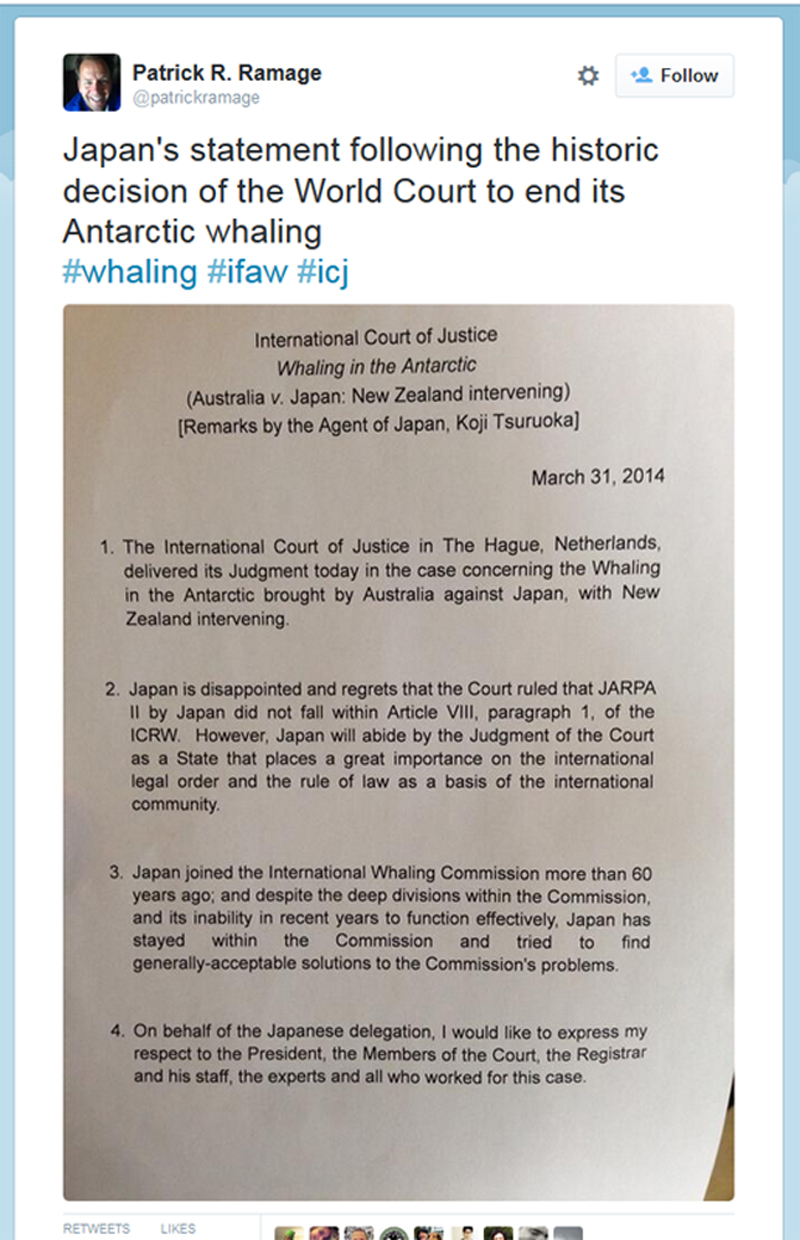
Click to enlarge the image.
After originally stating they would abide by the ICJ ruling, the Japanese government has now stated it will not accept any ruling from the International Court of Justice (ICJ) on any maters concerning;
“living resources of the sea…”
The decision to back away from its international obligations and agreements is a troubling one, when you take into consideration the language used. It could well have far-reaching consequences on our planet’s oceans at a time when our marine ecosystems are under great pressure and so many marine species are reported as being on the brink of collapse.
Embed from Getty Images
Several Japanese welfare organizations have also questioned not only the new program, but also the taxpayer burden and the Japanese government’s decision to amend its declaration to abide by the ICJ agreement.
In a joint statement posted on the Iruka & Kujira (Dolphin & Whale) Action Network (IKA-Net) website these organisations said;
“This new plan is the same plan that the expert panel of the International Whaling Commission concluded this January did not demonstrate the need for lethal sampling. This report was further supported by 44 scientists at the IWC Scientific Committee held in May.”
The statement goes onto say;
“The initial government subsidy to research whaling at the onset of the program was 500 million yen. The amount is increasing every year, and the current amount is 3.1 billion yen… also received an additional 4.5 billion yen last term, from the Fisheries Agency…”
It then calls the Institute of Cetacean Research “deficit-laden” due to “the shrinking market for whale meat.” followed with;
“It is clear that the operation that requires going out to distant international waters cannot make a good business.”
The statement concludes with;
“We, not only being Japanese, but also citizens of the Earth, cannot dismiss such an announcement by the government like the one made to the UN last month that ignores international agreements.
We strongly demand that the government not start any new research whaling programs, and instead take on new measures that contribute to ocean conservation.”
It’s also interesting to note that part of Prime Minister Shinzo Abe’s election district, Shimonoseki is home to much of Japan’s whaling fleet.
Embed from Getty ImagesThe Japanese whaling industry has been frought with allegations of corruption. In 2008 two activists from Greenpeace Japan exposed crew members of Japan’s whaling factory ship, the Nisshin Maru, for illegally trading prime cuts of whale meat. The crew were smuggling the meat ashore for personal gain and at the tax payers expense. The public prosecutor initially investigated the allegations however in the end the “Tokyo Two” were the ones arrested.
Embed from Getty Images
At the time Greenpeace reported that;
Embed from Getty Images“During the nearly three years it took for the case to be completed, Japanese media, human rights and environmental groups as well as politicians inside and outside Japan became increasingly convinced of the corruption within the industry. An extensive dossier outlining the investigation, containing interviews with whistleblowers from the whaling industry and documentation proving the embezzlement was presented to prosecutors and officials. Junichi and Toru’s principle defence was that taking the whale meat as evidence of the corruption was a reasonable action in order to carry out an investigation in good faith and in the public interest – as the whaling programme is funded by tax-payers money.”
In a case brought by Humane Society International, Kyodo Senpaku Kaisha (KSK), the Japanese government funded whaling company, was found “guilty of wilful contempt” This means contempt of the Australian Federal Court for conducting whaling activities in the Australian Antarctic Whale Sanctuary and was just last month fined AU$1,000,000. It is the first finding of contempt under Australia’s Environment Protection and Biodiversity Conservation Act.
KSK refuse to acknowledge this ruling. In 2008 when the original case was heard, Humane Society chief executive Michael Kennedy said the following in an ABC news interview;
“[Kyodo] simply did not recognise the injunction; they did not recognise the law, because they don’t recognise the Australian territory in the Southern Ocean,”
The Humane Society International went onto to say the following in its ‘HSI Technical Bulletin‘;
Embed from Getty Images“Despite the declaration and injunction issued in this case, ultimately enforcement of the prohibition against whaling in the Australia n Whale Sanctuary (AWS) under the EPBC Act rests on the shoulders of the new Australian Government. The Australian Government could stop the whaling by the respondent Japanese company by ordering an Australian customs or fisheries vessel to arrest the Japanese whaling company’s vessels operating in the AWS adjacent to Antarctica. Prior to being elected and prior to the injunction being issued by the Federal Court, the Australian Labor Party committed itself to “enforce Australian law banning the slaughter of whales in the Australian Whale Sanctuary”
In recent years Japanese whaling ships have entered Australian Exclusive Economic Zones illegally whilst chasing Sea Shepherd Conservation Society ships. This has resulted in Australian authorities ordering the whaling vessels out of the EEZ.
ALL THIS AND…
Two days prior to the whaling fleets departure Australian PM Malcolm Turnbull was quoted in the Sydney Morning Herald (SMH) he said;
“we… strongly encourage Japan to cease its whaling operations…”
On the 29th November 2015, Greens spokesperson for whaling, Senator Peter Whish-Wilson questioned the Government over what they are going to do to stop Japan re-starting whaling. The language used in the governments responses were disappointing at best.
With the Japanese whaling fleet on the move recent indications from the Australian government show there is the possibility that they may send the Customs Icebreaker, the Aurora Australis to the Southern Ocean. Although the question still remains as to what role it would play?
There are recognition issues regarding zoning in the Southern Ocean and this has, in past years, been offered as a reason why Australia has not asserted itself during the previous whale hunts in the Southern Ocean. While Malcolm Turnbull is in Paris with the very people he needs to speak with, those with claims in the region. Shouldn’t he raise the issue? Shouldn’t he make time to talk to them, and let them know he cares about what the word ‘sanctuary’ means and then stand tall and send the Aurora Australis to the Southern Ocean?
It’s wonderful to see the British have already publicly stated their Royal Navy ice-class vessel the HMS Protector, will be keeping an eye out for the Japanese whaling fleet while it conducts fisheries patrols in the Southern Ocean.
Some are even calling for whaling to be prioritized in trade negations. Senator Peter Whish-Wilson during an SBS interview, suggested the Australian government move away from legal diplomacy and onto diplomacy within trade agreements via the use of incentives or disincentives depending on how you want to see it.
On 30th November (the day prior to the Whaling fleet departing) Japan submitted a bid along with two others tenders, for a lucrative contract to supply a new fleet of submarines for the Australian Navy. This opens up an opportunity for Australia to tell the Japanese government that, while it continues to hunt whales, Australia will not consider any such tenders.
There has been some speculation regarding whether Sea Shepherd Conservation Society (SSCS) would participate in anti-whaling activities after Japan’s latest departure.
On 9th November 2015 SSCS announced its second campaign to stop illegal fishing for toothfish aka “Chilean Sea Bass,” in the Southern Ocean, Operation Icefish
“will once again focus its attention on defending the pristine waters of Antarctica, with the aim to eliminate illegal fishing of vulnerable toothfish from the region.”
The speculation was magnified by this article from SMH which states
‘…the anti-whaling activists of Sea Shepherd said they would not be chasing the whaling fleet this summer, with two of their ships in dry dock, and a third, the Melbourne-based Steve Irwin, hunting illegal Antarctic fishers.”
However, shortly after the whaling fleet left Japan SSCS announced a new anti-whaling campaign with a difference, Operation Ultimate Justice.
Embed from Getty Images“For years, Sea Shepherd took direct action against the whalers on the seas, saving one whale at a time from the Japanese harpoons,” said Sea Shepherd Founder Captain Paul Watson. “But if we are to bring the illegal slaughter to an end once and for all, we cannot simply defeat the Japanese whalers on the water; we need to defeat them in the courts.”
It remains to be seen what the SSCS flagship, Steve Irwin will do if during Operation Icefish they happen to come across any of the Japanese Whaling Fleet.
One thing is for sure, if you are an Aussie that doesn’t support whaling and want to see your government do more to stop it from happening in Antarctic waters, you need to speak up, get in touch with your local federal MP and let them know this is an important issue to you and you want to see Australia do more, you want to see the whaling issue prioritized and discussed when talking trade with Japan. And it’s not just the Australians who need to raise their voices, those of you out there who want to see and end to whaling. It’s time to make some noise.
Embed from Getty Images





 Dollars Voice Ethics